“AI didn’t create Rocket Horse or give us our first audience.”
By his account, independent press, a film placement and traditionally produced releases all came before generative production. Brian Myk puts roughly 50 recordings on the traditional side, and makes the final call on every release.
Octa is Octaverum’s app; this feature is published by its maker. Every figure below is his, given in writing.
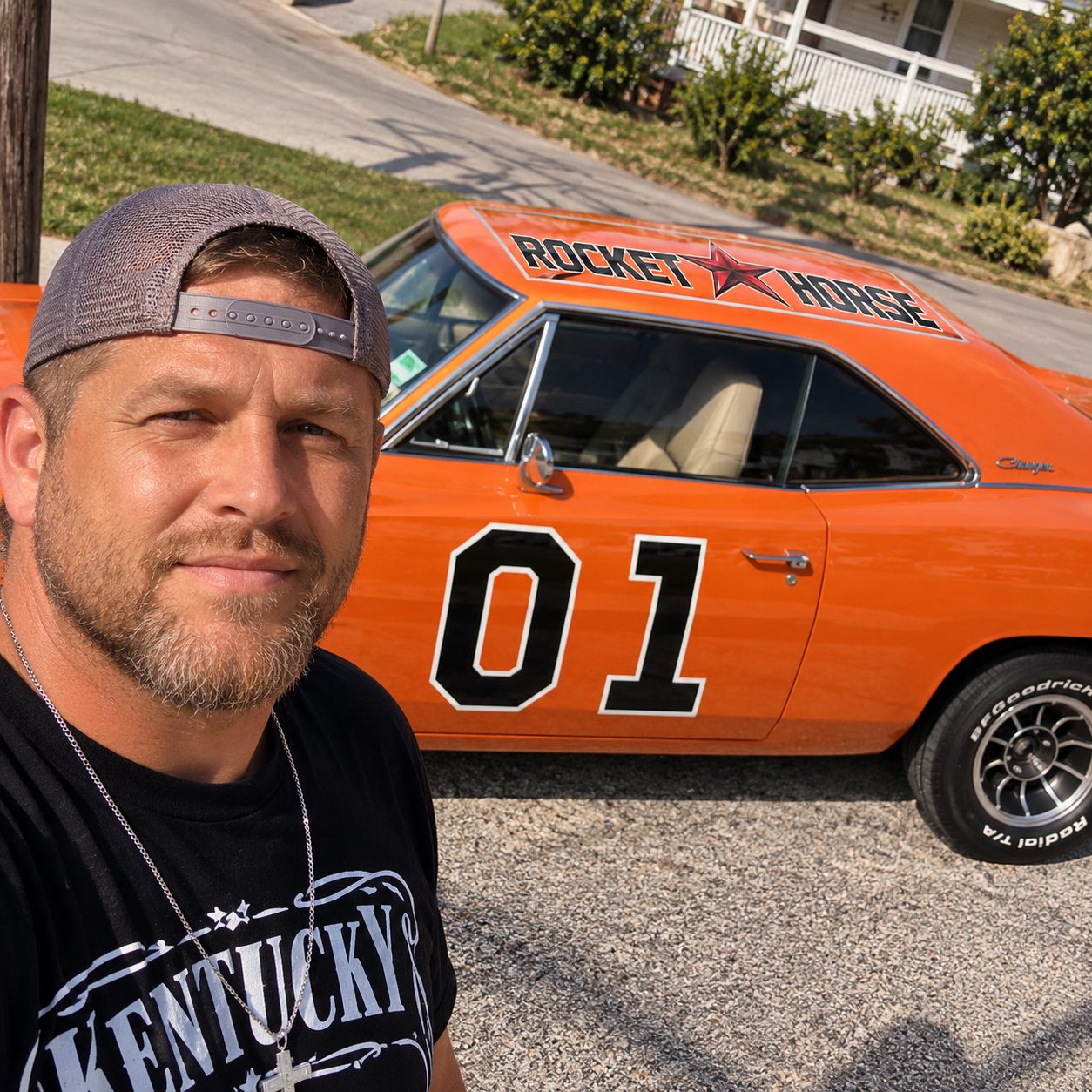
Before any of this
Brian Myk rejects considerably more of what comes back from generative production than he keeps. He is a BMI songwriter from North Georgia. Rocket Horse is, in his description, “a songwriter-led independent music project built around my writing.”
He leads with the order of events. “Rocket Horse was already an established project before generative production became part of what I do,” he writes. “We had traditionally recorded music, independent press and reviews, a substantial social following, and our traditionally produced song ‘Revolution’ was featured in the film How to Cook a Frog.”
“AI didn’t create Rocket Horse or give us our first audience.”
Generative production, he writes, “came much later for Rocket Horse.” Roughly 50 of the recordings, by his count, come from the traditional, non-generative side of the catalog. He was writing and recording that way, with musicians and studios, long before these tools existed.
He puts the catalog at around 170 released or release-ready songs. “Musically, there isn’t one standard Rocket Horse sound. That’s intentional.” It can move through rock, alternative, country-rock, Americana and pop, depending on what he thinks serves the song.
“The common denominator isn’t a genre or a production method. It’s the songwriting.”
“A weak song with impressive production is still a weak song.”
What stays his
Lyrics, melodies, hooks, structure, subject matter and the emotional decisions about what the song is trying to say all begin with him: “Those are mine.” So is the final call. “I also make the final decisions about what stays, what gets changed, what gets thrown away and whether something is good enough to become a Rocket Horse release.”
“Speed and possibilities changed dramatically,” he writes. “I can explore directions for a song that traditionally could have required considerably more studio time, musicians and money.”
“What didn’t change is the part I care about most: the song.”
“I don’t look at AI as replacing songwriting,” he writes. “For me it’s another production tool surrounding songwriting.”
The AI-assisted release he points to is “Good Girls Party,” which came out on August 13, 2026. It comes from what he calls “the newer Rocket Horse workflow where I keep control of the songwriting and creative direction while using AI-assisted production to explore how the finished record can sound.”
A lot of Rocket Horse songs follow some version of the same back-and-forth between him and the production, and “Shotgun Wedding” is the one he offers as an example. “It started the same way my songs have always started—with me.” He names what was already in place: “The concept, lyrics, hook, melody and structure were established before generative production became involved.”

“Once I knew what the song was and what I wanted it to communicate,” he writes, “I brought AI into the production stage to explore different ways of bringing that song to life.”
“AI can produce something technically impressive while completely missing the feeling that made you write the song in the first place.”
“But I don’t just hand a song over at that point and accept whatever comes back. That’s actually where another part of the work begins.”
Then he listened. “With ‘Shotgun Wedding,’ I listened for exactly those moments. Where did the production help the song? Where did it become too polished, mechanical or emotionally disconnected?”
“Then I took control again—changing direction, adjusting phrasing and structure, rejecting things that didn’t connect, and pushing the production toward something that had more of the human feeling and emotional connection I wanted from the song.”
He puts the sequence in one line, with his own arrows. “That’s probably the simplest description of my process: human idea → AI exploration → human judgment and intervention → finished Rocket Horse record.” The middle of that sequence has a limit. “AI can expand the possibilities in the middle, but I don’t want it making the final emotional decisions.”
“The finished song still has to make me feel something. If it doesn’t, it isn’t finished.”
What he throws away
“I reject considerably more than I keep.”
The first failure he names is not a failure of craft. “Sometimes something can be technically impressive but emotionally wrong. Sometimes it misses the melody, changes the phrasing, buries the hook or simply doesn’t feel like the song I wrote.”
“I don’t have a fixed number of takes,” he writes. “Some songs come together surprisingly quickly. Others can take a lot of attempts.”
“I’m perfectly willing to throw away twenty interesting versions if none of them captures what I’m trying to do.”
None of that makes him hostile to a result he did not plan for. “That’s one of the things I find interesting about the technology. Sometimes it interprets a rhythm, pause, harmony or arrangement differently than I originally heard it in my head, and occasionally the surprise is better.”
Novelty on its own buys nothing. “I don’t keep something simply because AI did something unexpected. But if an accident genuinely makes my song stronger, I’m not afraid to recognize that and use it.”
The last gate is the one he applies to every release, and it asks nothing about how the record was made. “One question I ask myself is: would I want to hear this again if I hadn’t made it?” The follow-ups are short: “Does the hook stick?” and “Does it sound finished?”
“If I’m having to make excuses for it, it’s probably not ready.”
Control
Asked what Octa does well for his work, he answers with speed. “What I like most is being able to explore possibilities quickly. For somebody producing a large catalog, speed matters. I don’t want production to become the bottleneck between writing a song and discovering what that song could become.”
That is the whole of the praise, offered in answer to a question about the app.
“The biggest weakness I see with generative music tools generally is control.”
He puts the difficulty in the gap between impressive and intended. “Getting something impressive isn’t necessarily the hardest part. Getting something impressive that follows the specific creative decisions you intended can be much harder.”
Given one change to the app, this is where he would spend it. “More precise control without losing what is already working.”
“If I have a version where 90 percent is exactly what I want, I would love increasingly precise ways of changing the remaining 10 percent without gambling the other 90 percent again.”
The slow part
What costs him most comes after the record is done. “Promotion and getting the song in front of the right people, without question.” The list he gives next starts where the music stops. “Making the music is only part of the job now. After that comes artwork, distribution, radio, playlists, press, social media, interviews, licensing and pitching.”
“Rocket Horse is experiencing a lot of momentum right now, which is exciting, but it also means there is more to keep up with,” he writes.
“Getting people to discover a song can take considerably longer than making the song.”

Brian Myk
Brian Myk is a BMI songwriter from North Georgia. Rocket Horse is the songwriter-led independent music project built around his writing.